CSR Initiatives
Why Choose IndiaNPIM?
- Expertise: Our team comprises experienced professionals with a deep understanding of agricultural practices and renewable energy solutions.
- Tailored Solutions: We customize our projects to meet the unique needs of each community, ensuring maximum impact and sustainability.
- Commitment to Sustainability: We are dedicated to promoting environmentally friendly practices that benefit both farmers and the planet.
- Long-term Partnerships: We believe in building lasting relationships with communities, supporting them in their journey towards sustainable agriculture.
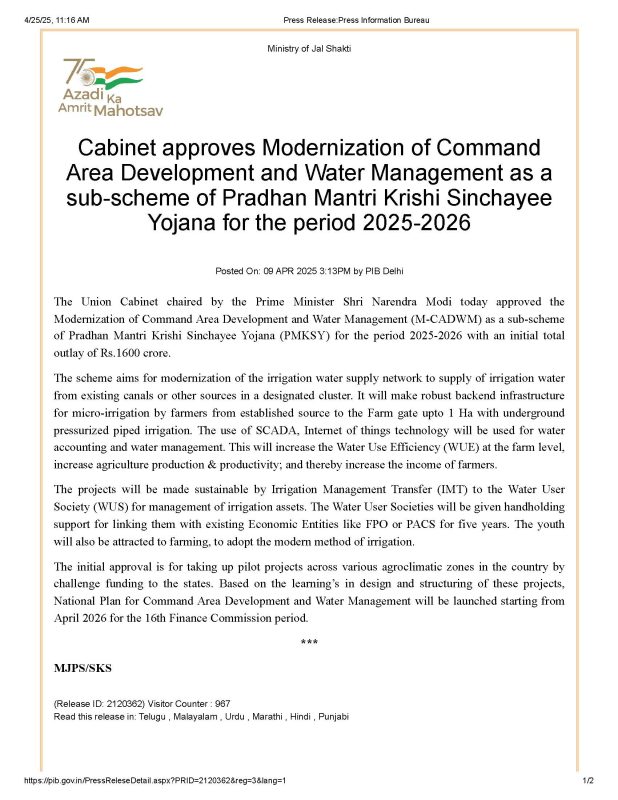
- Connected with Ministry of Jal Shakti, Govt. of India for MCAD ( Modernization of the Command Area Development) Scheme , Atal Bhujal Yojna
Our Approach
We follow the MCAD Principles and will saturate the clusters where the Govt. of India is working.
| Principle 1 – Cluster as the working level in the Command Area. The large command area will be divided into clusters. The size of the cluster may be from 50 ha (for small states) to a maximum of 5000 ha (for large states). The size of the cluster determines the economic strength of the Water User Society. It can be a administrative boundary. The convergence of all Government sponsored benefit schemes shall be done at cluster level. |
| Principle 2 – The Water User Society (WUS) will manage the water in the Cluster. It will receive the bulk water from the Department and charge its members It can be constituted under Society Registration Act 1860, Co-operation Act as suitable to State. The WUS will be subject to Annual Audit by the Government. The WUS will have a elected voluntary hierarchy system: |
| At maximum size: 5000 ha Cluster: headed by Pani Pradhan ( PP) |
| At 1000 ha Division: headed by Deputy Pani Pradhan ( DPP) |
| At 300ha (Village / Zone) : headed by Gram Pani Pradhan (GPP) |
| At 30 Ha Chak for Chak Committee (CC) : headed by Chak Pani Pradhan (CPP) |
| At 5 ha Sub Chak Committee (SCC) : headed by Jal Mitra (JM) |
| Principle 3: All the water sources in the Cluster will be Integrated. This may include the community GW well, Canal water, Minor Irrigation structures, community ponds, available recycled water |
| Principle 4 – The water supply for irrigation from integrated sources shall be able to deliver at Water Use Efficiency of 75% and above through underground Pressurized Piped Water Network. The farmers will use water efficient micro irrigation or community based center pivot systems for farming. |
| Principle 5 – Water Accounting through use of technology like SCADA, IoT and link up with satellite ET based Water Management system to ensure operational Water Use Efficiency at all crop seasons. |
| Principle 6 – For Irrigation as Service, the erection contractors will be roped in as Irrigation Service Providers with long term contracts (5 years and above) and report to the WUS |
CSR WORKS FOR IRRIGATION WATER
CSR initiatives play a crucial role in supporting irrigation efforts by addressing water scarcity, promoting sustainable practices, and improving irrigation infrastructure. This includes projects focused on rainwater harvesting, water-efficient irrigation systems like drip irrigation, watershed management, and even reviving traditional irrigation systems. The CSR initiatives in irrigation will be Supporting Agriculture and Rural Development as it directly impacts:
- Improved Agriculture Productivity: By investing in irrigation infrastructure and sustainable practices, CSR initiatives contribute to increased crop yields and improved agricultural productivity.
- Increased Income for Farmers: Improved irrigation systems and access to water can lead to higher income for farmers, as they can grow more crops and diversify their farming practices.
- Rural Development: CSR Irrigation projects in irrigation can contribute to overall rural development by improving water availability for both agriculture and domestic use.
- Preventing Soil Degradation: CSR can promote practices like organic farming and water-efficient irrigation to prevent soil degradation and maintain soil fertility.
- Soil and Water Conservation: CSR initiatives often focus on soil and water conservation measures to improve water availability and prevent erosion
CSR INITIATIVES by IndiaNPIM
- Improving Water Source and Availability:
- Small water source for augmentation: This involve constructing or rejuvenating rainwater harvesting structures, ponds, wells, check dams, desilting of the ponds to recharge groundwater and ensure water availability throughout the year.
- Integration of the water sources: The integration of the different water sources and clubbing them together in engineered manner ensure water availability for all and reduction in the losses.
- Providing individual water storages to the farmer: To maintain water security and efficiency and to curb the GW exploitation, individual farmers may be given contributory grants to install underground poly tank of 10 KL or higher
- Watershed Management: Improving watershed management to enhance water infiltration, reduce runoff, and increase water availability in the area through afforestation, catchment area treatment and sediment trapping.
- Reviving Traditional Irrigation Systems: Restoring and improving traditional irrigation systems, like those used in Tamil Nadu, to improve water efficiency and accessibility.
- Community based GW sources: This includes drilling deep tube wells to access groundwater and provide irrigation facilities. Installation of community based solar water pumps.
- Creating Infrastructure to apply treated waste water for Irrigation: This includes creating infrastructure for the reuse of power plant treated water, tertiary treated STP water for agriculture.
- Reclaiming water logged areas: Saline and areas reclamation for improvement of the Agriculture Productivity
- Promoting Water Use efficiency in Irrigation Practices
- Creating Water-Efficient Irrigation Infrastructure: Implementation of the water-efficient irrigation systems infrastructure before the farm.
- Micro-Irrigation use by farmers: Bringing Micro-irrigation kits like drip and micro-sprinkler systems to all farmers in the cluster.
- Promoting Centre Pivot System: Creating community based Centre Pivot system. Supporting financially to the community contributions
- Promoting Water Efficient Crops: The water efficient crop variety seeds, high-yield variety of seeds developed by ICRISAT are distributed for increased crop yields and improved agricultural productivity by SRI (System of Rice Intensification) and DSR (Dry seeded Rice).
- Promoting the water efficient supplements: fertilizers like vermin compost, mulching materials etc.
- 3. Introducing Technology for Irrigation Management
- Installation of IoT devices for Individual Farms: to improve water accounting, soil health indicators, soil moisture indicators, system starters
- Membership of the Farmer App: for Satellite Based Water Accounting System
- Arranging hackathons’: for the startups and innovators
- Data Collection and AI based support: Collection of the crop data for diversification, rotation, GW Use
- Social Management & Social Infrastructure
- Creating Water User Societies through a Farmer Relationship Agency
- Linking WUS with Agri business in the cluster: WUS can be linked with FPO/ PACS, dairying, goat farming, mushroom farming, other extension fields
- Developing Farmer Training School: To develop “Model Sites of Learning”
- Promoting and delivering Shared sprinklers set, tractorization, drones support
- Developing Farmer Market: With the contribution of the Farmers land, a standing Farmer market or Exhibition ground can be created.
- Convergence support for Government of India Schemes in a cluster: Support like EV charging station, Telecom optical fibre, Agri Processing Unit etc.
- Irrigation Social Impact Research: Collection of the significant and focused information of the irrigation projects in collaboration with the State Governments to develop an economic benchmark line.
- Community Outreach, Engagement and Training
- Training sessions: and knowledge sharing on best practices and workshops to equip farmers with the knowledge and skills needed to operate and maintain solar and lift irrigation systems, good agricultural practices, income generation activities, best practices for land use and crop planning, crop diversification, bio-dynamic farming practice for optimizing the water use.
- Skill Development: skills in agriculture and allied occupations for local youth, Training on the cultivation of cash crops, horticulture crops
- Exposure Visits: of the farmers to the successful projects.
- Distributing Kits: Micro Irrigation cleaning, Soil and Water Testing, various equipment like anti hail nets, power sprayers, pruners,
- Soil health cards: to the farmers in the villages to make them aware of the usage of fertilizers and pesticides based on individual soil health conditions.
- Distribution of the Fertigation Machines: to control the dosages of the fertilizers and promoting the micro irrigation
- Water Campaigns: ‘Water the Plant not the soil’ aimed at supporting Indian farmers for water education. It may be linked with a digital crowd funding campaign for supporting farmers in distress in water short regions and rainfed dependent farmers.